Monday, 5 August 2013

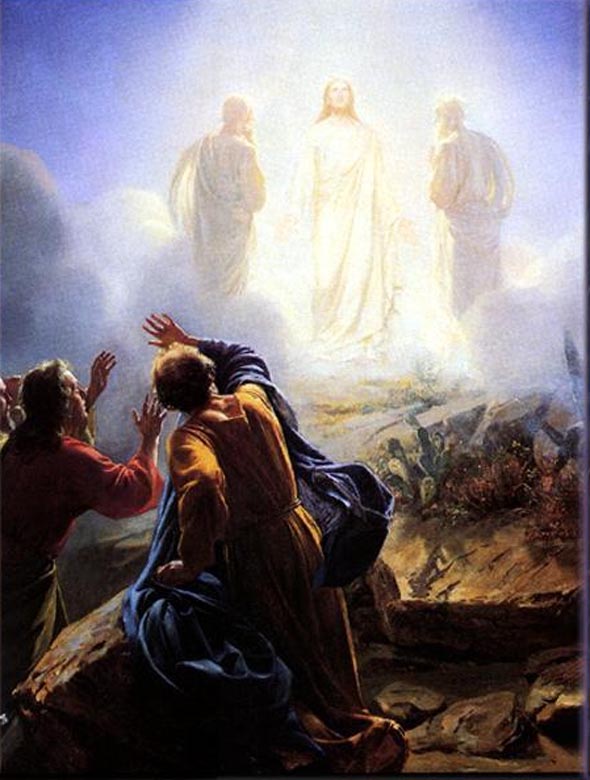
And now for something completely different! The Transfiguration of Jesus

The Transfiguration of the Lord - Feast - Year C     6 August 2013

First reading from the book of Daniel 7:9-10.13-14.


(This is where we get most of our childhood images of what God looks like.)

As I watched : Thrones were set up and the Ancient One took his throne. His clothing was bright as snow, and the hair on his head as white as wool; His throne was flames of fire, with wheels of burning fire.
A surging stream of fire flowed out from where he sat; Thousands upon thousands were ministering to him, and myriads upon myriads attended him. The court was convened, and the books were opened.
As the visions during the night continued, I saw One like a son of man coming, on the clouds of heaven; When he reached the Ancient One and was presented before him,
He received dominion, glory, and kingship; nations and peoples of every language serve him. His dominion is an everlasting dominion that shall not be taken away, his kingship shall not be destroyed.


Ps 97(96):1-2.5-6.9.

The LORD is king; let the earth rejoice;
Let the many islands be glad
Clouds and darkness are round about him,
Justice and judgment are the foundation of his throne.

The mountains melt like wax before the LORD,
Before the Lord of all the earth.
The heavens proclaim his justice,
And all peoples see his glory.

You, O LORD, are the Most High over all the earth,
exalted far above all gods.

Luke 9:28b-36.

About eight days after he said this, he took Peter, John, and James and went up the mountain to pray.
While he was praying his face changed in appearance and his clothing became dazzling white.
And behold, two men were conversing with him, Moses and Elijah,
who appeared in glory and spoke of his exodus that he was going to accomplish in Jerusalem.
Peter and his companions had been overcome by sleep, but becoming fully awake, they saw his glory and the two men standing with him.
As they were about to part from him, Peter said to Jesus, "Master, it is good that we are here; let us make three tents, one for you, one for Moses, and one for Elijah." But he did not know what he was saying.
While he was still speaking, a cloud came and cast a shadow over them, and they became frightened when they entered the cloud.
Then from the cloud came a voice that said, "This is my chosen Son; listen to him."
After the voice had spoken, Jesus was found alone. They fell silent and did not at that time tell anyone what they had seen.


Commentary of the day :

Old man Sam was a witness in a burglary case. The defense lawyer asked Sam, "Did you see my client commit this burglary?" "Yes," said Sam, "I saw him plainly take the goods." The lawyer asks Sam again, "Sam, this happened at night. Are you sure you saw my client commit this crime?" "Yes," says Sam, "I saw him do it." Then the lawyer asks Sam, "Sam, listen, you are 80 years old and your eye sight is probably bad. Just how far can you see at night?" Sam says, "I can see the moon, how far is that?"


In a trial, a small-town prosecuting attorney called his first witness, a grandmotherly, elderly woman to the stand. He approached her and asked, "Mrs. Jones, do you know me?"  She responded, "Why, yes, I do know you, Mr. Smith. I've known you since you were a young boy, and frankly, you've been a big disappointment to me. You lie, you cheat on your wife, and you manipulate people and talk about them behind their backs. You think you're a big shot when you haven't the brains to realize you never will amount to anything more than a two-bit paper pusher. Yes, I know you."

The lawyer was stunned! Not knowing what else to do, he pointed across the room and asked, "Mrs. Jones, do you know the defense attorney?" She again replied, "Why, yes, I do. I've known Mr. Bradley since he was a youngster, too. He's lazy, bigoted, and he has a drinking problem. He can't build a normal relationship with anyone and his law practice is one of the worst in the entire state. Not to mention he cheated on his wife with three different women. One of them was your wife. Yes, I know him."

The defense attorney almost died.  The judge asked both counselors to approach the bench and, in a very quiet voice, said, "If either of you idiots asks her if she knows me, I'll send you to the electric chair."

Anecdote 1: Lord, give me the grace to change the world! The word transfiguration means a change in form or appearance. Biologists call it metamorphosis, a modification of the Greek word metamorphooma used in Mark’s gospel to describe Christ’s transfiguration.  Biologists use it to describe the change that occurs when a caterpillar turns into a chrysalis and then bursts into a beautiful Monarch butterfly. Fr. Anthony De Mello tells the funny story of a metamorphosis in the prayer life of an old man.  “I was a revolutionary when I was young and all my prayer to God was: “Lord, give me the grace to change the world.” As I approached middle age and realized that half of my life was gone without changing a single soul, I changed my prayer to: “Lord, give me the grace to change all those who come in contact with me; just my family and friends and I shall be satisfied.” Now that I am old and my days are numbered, I have begun to see how foolish I have been. My one prayer now is: “Lord, give me the grace to change myself.”  If I had prayed for this right from the start I should not have wasted my life.'

Introduction: The common theme of today’s readings is metamorphosis or transformation. The readings invite us to transform our lives by renewing it on a daily basis, radiating the grace of the transfigured Lord around us by our Spirit-filled lives. The first reading from the book of Daniel explains how the “Son of man” coming on the clouds of heaven, gets transformed by receiving dominion, glory and kingship from the Ancient One seated on the throne of heavenly glory. In the second reading, St. Peter explains to his Christian community how he was an eye witness to the transfiguration scene when Jesus received honour and glory from God the Father.       

Exegesis:   The primary purpose of Jesus’ transfiguration was to consult His heavenly Father and ascertain His plan for Our Lord’s suffering, death and resurrection.  The secondary aim was to make his chosen disciples aware of his divine glory so that they might discard their worldly ambitions about a conquering political Messiah and not to get discouraged at his suffering and humiliating death.  The Transfiguration took place in late summer, just prior to the Feast of Tabernacles.  Hence the Orthodox tradition celebrates the Transfiguration at about the time of the year when it actually occurred, in order to connect it with the Old Testament Feast of Tabernacles.  The Western tradition normally celebrates the Feast of Transfiguration at the beginning of Lent.

The location of transfiguration was probably Mount Hermon in North Galilee, near Caesarea Philippi, where Jesus camped a week before the transfiguration. It was a desolate mountain, 9200 feet high. The traditional oriental belief that transfiguration took place on Mount Tabor is based on Psalm 89:12.  But Mount Tabor was a small mountain, in the south of Galilee, less than 1000 feet high and with a Roman fort built on it.  Hence it would have been an unlikely place for solitude and prayer.

 The scene of heavenly glory:   While praying, Jesus was transformed into a shining figure, full of heavenly glory.   This reminds us of Moses and Elijah who had also    experienced the Lord in all His glory.  Moses had met the Lord in the burning bush at Mount Horeb (Exodus 3:1-4). After his encounter with God, Moses' face shone so brightly that the people were so frightened, and Moses had to wear a veil over his face (Exodus 34:29-35).  Elijah traveled for forty days to Mt. Horeb on the strength of the food brought by an angel (1 Kings 19:8).  At Mt. Horeb, Elijah sought refuge in a cave as the glory of the Lord passed over him (1 Kings 19:9-18).  Finally, Elijah was taken directly to heaven in a chariot of fire without seeing death (2 Kings 2:11 -15).

 These representatives of the Law and the Prophets foreshadowed   Jesus who is the culmination of the Law and the Prophets.  Both prophets were initially rejected by the people but vindicated by God. The Jews believed that Elijah did not die because he was carried to heaven in a whirl wind (II Kings 2:11). When Moses died God himself buried him in a secret place in the valley of Moab (Deut 34:  5-6).  So the implication is that, although God spared Elijah from the normal process of death and honoured Moses by burying him, He did not spare His Son from suffering and death.

God the Father’s voice from the cloud: The book of Exodus describes how God spoke to Moses at Mount Sinai from the cloud.  God often made appearances in a cloud (Exodus 24:15-17; 13:21 -22; 34:5; 40:34; 1 Kings 8:10-11).     The First Book of   Kings, 8: 10,  tells us how by the cover of a cloud, God revealed His presence in the Ark of the Covenant and in the temple of Jerusalem on the day of its dedication.  The Jews generally believed that the phenomenon of the cloud would be repeated when the Messiah arrived.  God the Father, Moses and Elijah approve the plan regarding Jesus' suffering, death and resurrection.  God’s words from the cloud: “This is my Son, the Beloved; with him I am well pleased; listen to him,” are the same words used by God at Jesus' baptism (3:17).  They summarize the meaning of the Transfiguration:  on this mountain, God reveals Jesus as His son -- His beloved -- the one in whom He is well pleased and to whom we must listen.  

Life messages: (1) The transfiguration in the Holy Mass as a source of our strength. In each Holy Mass the bread and wine the priests offer, get transfigured into the body and blood of Jesus. In other words, our Divine Lord is transfigured before our eyes taking the form of bread and wine. Hence, just as the transfiguration strengthened the apostles in their time of trial, each Holy Mass should be the source of heavenly strength against our own temptations, and a source of renewal of our lives every day.  In addition, communion with Jesus should be a source of daily transfiguration of both our minds and hearts.  We must also be transformed into Christ by becoming more humble and selfless, sharing our love, compassion and forgiveness with others.

(2) Each sacrament that we receive transforms us.   Baptism, for example, transforms us into sons and daughters of God and heirs of heaven.  Confirmation makes us the temples of the Holy Spirit and warriors for Him. By the sacrament of reconciliation, God brings back the sinner to the path of holiness. The Holy Eucharist enables us to share the life of God in this world.

(3) A message of hope and encouragement.  In moments of doubts and during feelings of despair, the expectation and assurance of our transfiguration in heavenly glory helps us to reach out to God and listen to His consoling words: “This is my beloved son / daughter in whom I am well pleased.”

 (4) We need 'mountain top experiences’ in our own lives. We can share such experiences as those of Peter, James and John when we spend some extra time in prayer every day, talking to God and listening to Him.  The meditative reading of the Bible daily enables us to hear God speaking to us and directing our lives as the three apostles experienced on the mountain of transfiguration. We have also other moments when we see and feel the glory of God surrounding us. Every Sunday we are invited by God to come to His table and to partake of the heavenly banquet. We are called to come forward like Peter, James and John to be in the presence of Christ. Perhaps when we come to this table we have an opportunity for a theophany. Perhaps God is inviting us in order to help us see the identity of Christ more clearly. Perhaps God is calling us to help us experience the miracle of the cross and the resurrection more deeply. Whatever be the result, there is one thing of which we can be assured. God always calls us to join in the journey. God calls us to have 'mountain top experiences’ in our own

I am amazed how many people answer the question: “Why do Catholics consider going to Mass important to them?” With the answer: “To make them a better person” or “To forgive their sins” and then still see no reason to actually make Mass-going part of their own spiritual life..


Saint Leo the Great (?-c.461), Pope and Doctor of the Church
Sermon 51, 2-6 ; SC 74 bis

"The glory to be revealed in us” (Rm 8,18)


“Jesus took Peter, James and John his brother” and, taking them up a high mountain apart, he revealed to them the radiance of his glory. For, even if they had understood that God's majesty dwelt within him, they did not realize that his body, veiling his divinity, shared in God's power. This is why, only a few days before, our Lord had expressly promised that “some of those here” among his disciples, “will not taste death before they have seen the Son of Man coming in his Kingdom” (Mt 16,28), that is to say in the kingly splendor... particularly suited to the human nature he had assumed...This transfiguration had as its first purpose to remove the scandal of the cross from the disciples' hearts, so that the humiliation of his Passion, voluntarily suffered, would not disturb the faith of those who had witnessed the greatness of his hidden dignity. But, with the same foresight, the transfiguration fixed in Jesus' Church the hope intended to sustain it so that the members of Christ's Body might understand what sort of change would one day be brought about also in them. For they were called to share the same glory they had seen shining in their Leader and Head. Our Lord himself had said in this regard, speaking of the majesty of his coming: “Then the righteous will shine like the sun in the Kingdom of their Father” (Mt 13,43). And the apostle Paul stated the same thing when he said: “I consider that the sufferings of this present time are as nothing compared with the glory to be revealed in us” (Rm 8,18). And elsewhere: “For you have died and your life is hidden with Christ in God. When Christ you life appears, then you too will appear with him in glory” (Col 3,3-4).


Sunday, 4 August 2013

To say nothing of women and children

Monday of the Eighteenth week in Ordinary Time  5 August 2013

First reading from the book of Numbers. 11:4b-15.


The children of Israel lamented, "Would that we had meat for food!
We remember the fish we used to eat without cost in Egypt, and the cucumbers, the melons, the leeks, the onions, and the garlic.
But now we are famished; we see nothing before us but this manna."
Manna was like coriander seed and had the appearance of bdellium.
When they had gone about and gathered it up, the people would grind it between millstones or pound it in a mortar, then cook it in a pot and make it into loaves, which tasted like cakes made with oil.
At night, when the dew fell upon the camp, the manna also fell.
When Moses heard the people, family after family, crying at the entrance of their tents, so that the LORD became very angry, he was grieved.
"Why do you treat your servant so badly?" Moses asked the LORD. "Why are you so displeased with me that you burden me with all this people?
Was it I who conceived all this people? or was it I who gave them birth, that you tell me to carry them at my bosom, like a foster father carrying an infant, to the land you have promised under oath to their fathers?
Where can I get meat to give to all this people? For they are crying to me, 'Give us meat for our food.'
I cannot carry all this people by myself, for they are too heavy for me.
If this is the way you will deal with me, then please do me the favor of killing me at once, so that I need no longer face this distress."


Ps 81(80):12-13.14-15.16-17.

My people heard not my voice,
and Israel obeyed me not;
So I gave them up to the hardness of their hearts;
they walked according to their own counsels.”

“If only my people would hear me,
and Israel walk in my ways,
Quickly would I humble their enemies;
against their foes I would turn my hand.”

“Those who hated the LORD would seek to flatter me,
but their fate would endure forever,
While Israel I would feed with the best of wheat,
and with honey from the rock I would fill them.”

The Gospel of St Matt 14:13-21.

When Jesus heard of the death of John the Baptist, he withdrew in a boat to a deserted place by himself. The crowds heard of this and followed him on foot from their towns.
When he disembarked and saw the vast crowd, his heart was moved with pity for them, and he cured their sick.
When it was evening, the disciples approached him and said, "This is a deserted place and it is already late; dismiss the crowds so that they can go to the villages and buy food for themselves."
(Jesus) said to them, "There is no need for them to go away; give them some food yourselves."
But they said to him, "Five loaves and two fish are all we have here."
Then he said, "Bring them here to me,"
and he ordered the crowds to sit down on the grass. Taking the five loaves and the two fish, and looking up to heaven, he said the blessing, broke the loaves, and gave them to the disciples, who in turn gave them to the crowds.
They all ate and were satisfied, and they picked up the fragments left over --twelve wicker baskets full.
Those who ate were about five thousand men, to say nothing for women and children.


Commentary of the day :
 
The last words of today's Gospel passage in the context of the Catholic celebration of the Eucharist are very telling. The role of women in the Church's liturgy is pretty well reserved officially to menial tasks. Women are still officially excluded from priesthood, deaconate, being acolytes, lectors (reading the Scriptures) and in some countries are still not permitted to distribute Holy Communion.
The reason you have seen them exercising these ministries in some parishes is because some priests ignore the chauvinism of the Church's hierarchy and besides there's no enough men coming to church for them to do everything!
IT is obvious from the way the Mass is structured that it is not intended that children perform any role other than assist the priest at the altar and parrot back the responses to prayers which they have no hope of understanding.
This thought came home very strongly to me at Mass yesterday when I watched the priest deliver every word of his homily to the adults in his congregation as the children around me in the congregation were just playing with their phones or chatting to each other.
I don't think that Jesus intended His Church to be so unfriendly.
The Mass is not a re-enactment of the Last Supper where no women or children were invited. It is a memorial of the Sacrifice of Jesus Christ instituted at the Last Supper for His priests (the apostles) so they would know what to do when they followed His instructions: "Do this in memorial of Me"


Blessed John-Paul II, Pope from 1978 to 2005
Encyclical « Ecclesia de Eucharistia », 3-5

"Taking the five loaves... he said the blessing, broke the loaves, and gave them to the disciples"

The Church was born of the paschal mystery. For this very reason the Eucharist, which is in an outstanding way the sacrament of the paschal mystery, stands at the centre of the Church's life. This is already clear from the earliest images of the Church found in the Acts of the Apostles: “They devoted themselves to the Apostles' teaching and fellowship, to the breaking of bread and the prayers” (2:42). The “breaking of the bread” refers to the Eucharist. Two thousand years later, we continue to relive that primordial image of the Church. At every celebration of the Eucharist, we are spiritually brought back to the paschal Triduum: to the events of the evening of Holy Thursday, to the Last Supper and to what followed it. .. The agony in Gethsemane was the introduction to the agony of the Cross on Good Friday. The holy hour, the hour of the redemption of the world. Whenever the Eucharist is celebrated at the tomb of Jesus in Jerusalem, there is an almost tangible return to his “hour”, the hour of his Cross and glorification. Every priest who celebrates Holy Mass, together with the Christian community which takes part in it, is led back in spirit to that place and that hour. “Mysterium fidei! - The Mystery of Faith!”. When the priest recites or chants these words, all present acclaim: “We announce your death, O Lord, and we proclaim your resurrection, until you come in glory”. In these or similar words the Church, while pointing to Christ in the mystery of his passion, also reveals her own mystery: Ecclesia de Eucharistia – the Church's life is in the eucharist. By the gift of the Holy Spirit at Pentecost the Church was born and set out upon the pathways of the world, yet a decisive moment in her taking shape was certainly the institution of the Eucharist in the Upper Room. Her foundation and wellspring is the whole Triduum paschale, but this is as it were gathered up, foreshadowed and “concentrated' for ever in the gift of the Eucharist. In this gift Jesus Christ entrusted to his Church the perennial making present of the paschal mystery.


Saturday, 3 August 2013

Prove your faith. Send me money: Mass Readings & Reflection on Feast of St John Mary Vianney & Jesus teaching on wealth

Eighteenth Sunday in Ordinary Time - Year C    4 August 2013
St. John Mary Vianney, Priest (1786-1859) - Memorial
 
First Reading from Old Testament Book of Ecclesiasticus 1:2.2:21-23. 
(The Wisdom of Jesus Ben Sirach)

Vanity of vanities, says Qoheleth (the Preacher), vanity of vanities! All things are vanity!
For here is a man who has laboured with wisdom and knowledge and skill, and to another, who has not laboured over it, he must leave his property. This also is vanity and a great misfortune.
For what profit comes to a man from all the toil and anxiety of heart with which he has laboured under the sun?
All his days sorrow and grief are his occupation; even at night his mind is not at rest. This also is vanity.

Psalm 90

You turn man back to dust,
Saying, "Return, O children of men."
For a thousand years in your sight
Are as yesterday, now that it is past,
Or as a watch of the night.
You make an end of them in their sleep;
The next morning they are like the changing grass,

Which at dawn springs up anew,
But by evening wilts and fades.
Teach us to number our days aright,
That we may gain wisdom of heart.
Return, O LORD! How long?
Have pity on your servants!
 
Fill us at daybreak with your kindness,
That we may shout for joy and gladness all our days.
And may the gracious care of the LORD our God be ours;
Prosper the work of our hands for us!
Prosper the work of our hands!
 
 
Coloss. 3:1-5.9-11. 

Brothers and sisters:  If you were raised with Christ, seek what is above,  where Christ is seated at the right hand of God.
Think of what is above, not of what is on earth.
For you have died, and your life is hidden with Christ in God.
When Christ your life appears, then you too will appear with him in glory.
Put to death, then, the parts of you that are earthly: immorality, impurity, passion, evil desire, and the greed that is idolatry.
Stop lying to one another, since you have taken off the old self with its practices and have put on the new self, which is being renewed, for knowledge, in the image of its creator.
Here there is not Greek and Jew, circumcision and uncircumcision, barbarian, Scythian, slave, free; but Christ is all and in all.

 
Gospel of St. Luke 12:13-21. 

Someone in the crowd said to Jesus, "Teacher, tell my brother to share the inheritance with me."

He replied to him, "Friend, who appointed me as your judge and arbitrator?"

Then he said to the crowd, "Take care to guard against all greed, for though one may be rich, one's life does not consist of possessions."

Then he told them a parable. "There was a rich man whose land produced a bountiful harvest.

He asked himself, 'What shall I do, for I do not have space to store my harvest?'

And he said, 'This is what I shall do: I shall tear down my barns and build larger ones. There I shall store all my grain and other goods

and I shall say to myself, "Now as for you, you have so many good things stored up for many years, rest, eat, drink, be merry!"

But God said to him, 'You fool, this night your life will be demanded of you; and the things you have prepared, to whom will they belong?'

Thus will it be for the one who stores up treasure for himself but is not rich in what matters to God."


 Commentary:

 The minister was preoccupied with thoughts of how, after the worship service, he was going to ask the congregation to come up with more money than they were expecting for repairs to the church building. Therefore, he was annoyed to find that the regular organist was sick and a substitute had been brought in at the last minute. The substitute wanted to know what to play. "Here's a copy of the service," he said impatiently. "But you'll have to think of something to play after I make the announcement about the finances."
 During the service, the minister paused and said, "Brothers and Sisters, we are in great difficulty; the roof repairs cost twice as much as we expected, and we need $4,000 more. Any of you who can pledge $100 or more, please stand up." At that moment, the substitute organist intoned the national anthem. Almost everyone in the church instinctively stood up. And that is how the substitute became the regular organist!

This week all the remaining clergy of the Diocese of Parramatta will be assembling to dine sumptuously and drink copious quantities of free wine as they toast the ascetical and demonised patron saint of all diocesan priests, John Mary Vianney, the famed nineteenth century parish priest of a small town in France called Ars.

Today is a day of mixed feelings. I used to look up to him but… Well, I have told you that story in an earlier post. When I think of Saint John Mary Vianney I think of Fr John O’Neill at Doonside. This priest whom my parents drove from Springwood to the town next to Blacktown each Sunday to hear his tirades against his Bishop and fellow priests (most of whom he was right to criticise but for different reasons). Bishop Bede Heather is yet to be gaoled for his protection and concealment of known paedophiles who infiltrated his Diocese for decades.  He was also having an affair while diocesan Bishop (read about my story as a resident in his house in unholysilence.com).

Fr John O’Neill, Parish Priest of St John Vianney Parish at Doonside. Photo: Virginia Knight.
Anyway John O’Neill is also a close friend and ally of one of the notorious sexual predators I wrote about in Unholy Silence and for that association I was always suspicious of him (that and other aspersions cast against him by other homosexual priests).
Anyway he single-handedly turned my parents (well Mum mostly) into very negative, fault-finding condemners of the imaginary “trendy theology”. His assessment of my seminary and those who taught there (which may have been close to the mark) distorted their version of Catholic orthodoxy and turned my youngest sisters against the Catholic religion and probably contributed to converting my two youngest brothers Brendan and Sean into neo-conservatives and led them to Wagga Seminary to embark on a theological education that screwed them right up.

Brendan is currently still a priest (in a two horse town called Howlong) walking around in black & white collar (even when he comes home to visit his parents) and Sean is a lawyer father of seven.

Enough said about John Vianney, let’s turn to the Gospel.

My wife and I were watching a TV Mass this morning and the priest was discussing this Gospel warning people against the accumulation of wealth and then a message flashed on the screen asking people to send money to support this TV evangelism by donating by bank deposit or credit card to this account number or call this free call number. The irony was not lost on my beautifully perceptive wife who commented, “He is talking about giving up wealth and look at that!”

Yes the message of Jesus is being ignored by the men who profess to live evangelical poverty. I am sure there are many who do live a life of deprivation (like John Vianney apparently did and I am sure Fr John O’Neill at Doonside believes he is too.

But no priest I know is ever worried about where his next meal is coming from. He is not nervous to open the mail in case that electricity bill comes in, or anxious about how he is going to pay for his kid’s educational expenses. There are so many things when I was living as a priest I was oblivious to about the pressures faced by normal people as I preached about sacrificial giving to our Diocesan Development Fund three times a year!

It was only later towards the end of my vocational crisis when I saw the extreme opulence of the lifestyle of Bishop Anthony Fisher in his penthouse suite of the former Mercy Convent in Parramatta (overlooking Parramatta’s Victoria Park (home of many vagrants and mentally ill), with his private chef (George) cooking up Scotch fillet for his fellow clerical diners that the penny dropped! It was his comments about the vintage wine that accompanied the lavish meal that offended me. I could not imagine our Lord living that way.

So what did Jesus mean in his comments we read today?
I will leave it to someone more spiritual than I to elucidate for you:


 Saint Basil (c.330-379), monk and Bishop of Caesarea in Cappadocia, Doctor of the Church  Homily 6, on wealth ; PG 31,261f.


Building other barns


“You fool, this night your life will be demanded of you; and the things you have prepared, to whom will they belong?” This man's behaviour is more to be mocked than eternal punishment is severe. Indeed, what sort of plans are jostling within the mind of this man who is going to be taken from this world so soon?

“I will pull down my barns and build bigger ones.”

Now, I would gladly say to him: Well done! For the barns of unrighteousness are only worth pulling down. Destroy from top to bottom what you have built up dishonestly. Let those wheat stocks of yours, that have never brought comfort to anyone, disintegrate. Do away with all the buildings that shelter your greed, pull down their roofs, overturn their walls, expose the mouldering grain to the sun, bring the wealth imprisoned within it out of its prison...

“I shall tear down my barns and build even larger ones.” Once you have filled these up in their turn, then what are you going to do? Will you pull them down to rebuild others once more? Is this a worse madness than to be endlessly tormented: to build tenaciously and at once pull down? If that is what you want, you have the houses of the poor for your barns. “Build up treasures in heaven” : what is stored there “neither moth nor decay destroy, nor thieves break in and steal” (Mt 6,20).

Friday, 2 August 2013

Speak the truth even if no one wants to hear it

Reflection on Mass Readings for Saturday of the Seventeenth week in Ordinary Time  
3 August 2013

First Reading: Levit. 25:1.8-17. 

The LORD said to Moses on Mount Sinai,
"Seven weeks of years shall you count--seven times seven years--so that the seven cycles amount to forty-nine years. Then, on the tenth day of the seventh month let the trumpet resound; on this, the Day of Atonement, the trumpet blast shall re-echo throughout your land.

This fiftieth year you shall make sacred by proclaiming liberty in the land for all its inhabitants. It shall be a jubilee for you, when every one of you shall return to his own property, everyone to his own family estate.

In this fiftieth year, your year of jubilee, you shall not sow, nor shall you reap the after-growth or pick the grapes from the untrimmed vines.

Since this is the jubilee, which shall be sacred for you, you may not eat of its produce, except as taken directly from the field.

"In this year of jubilee, then, every one of you shall return to his own property.

Therefore, when you sell any land to your neighbour or buy any from him, do not deal unfairly.

On the basis of the number of years since the last jubilee shall you purchase the land from him; and so also, on the basis of the number of years for crops, shall he sell it to you.

When the years are many, the price shall be so much the more; when the years are few, the price shall be so much the less. For it is really the number of crops that he sells you.

Do not deal unfairly, then; but stand in fear of your God. I, the LORD, am your God.


Ps 67(66):2-3.5.7-8. 

May God have pity on us and bless us;
may he let his face shine upon us.
So may your way be known upon earth;
among all nations, your salvation.
 
May the nations be glad and exult
because you rule the peoples in equity;
the nations on the earth you guide.
 
The earth has yielded its fruits;
God, our God, has blessed us.
May God bless us,
and may all the ends of the earth fear him!
 
Gospel of St Matthew 14:1-12. 

At that time Herod the tetrarch heard of the reputation of Jesus and said to his servants, "This man is John the Baptist. He has been raised from the dead; that is why mighty powers are at work in him."

Now Herod had arrested John, bound (him), and put him in prison on account of Herodias, the wife of his brother Philip, for John had said to him, "It is not lawful for you to have her."

Although he wanted to kill him, he feared the people, for they regarded him as a prophet.

But at a birthday celebration for Herod, the daughter of Herodias performed a dance before the guests and delighted Herod so much that he swore to give her whatever she might ask for. Prompted by her mother, she said, "Give me here on a platter the head of John the Baptist."

The king was distressed, but because of his oaths and the guests who were present, he ordered that it be given, and he had John beheaded in the prison.

His head was brought in on a platter and given to the girl, who took it to her mother.

His disciples came and took away the corpse and buried him; and they went and told Jesus.

  Commentary of the day:


John the Baptist has always been a hero of mine. He spoke the truth even if it meant he lost his head for doing so. These days there are too many people afraid of speaking out about injustices or crimes for fear of reprisals, repercussion and many imply they will lose their job if they did.

I have spoken with a number of teachers in Catholic schools who now confide their knowledge of priest, brothers or lay principals whom they suspected of being pedophiles because of their excessive affection for one particular student (who was later found to have been abused).
These gutless cowards never said anything at the time because, as they now claim, “He was my boss. It was just my word against his. I didn’t have any tangible proof” or any other of a host of excuses which all allowed the abuse to continue. John the Baptist didn’t make excuses. He spoke the truth without fear.
There are a lot of sexually damaged people in society who may have been spared the depth of damage if someone who suspected that there was danger about, had said something.
What about John? He could have said, "Its none of my business". But we recognise him as a saint now because he didn't avoid responsibility.
He is an inspiration to those who us who tell the people above us in authority when they have done the wrong thing. We need more John the Baptists and less sycophants and cowards afraid to challenge the establishment.  

 Byzantine liturgy - Troparion and kathisma of matins of 29/08 (trans. Mother Mary of the Monastery of the Veil of the Mother of God, 1969)
 
 Behold I am sending my messenger ahead of you; he will prepare your way before you

“The memory of the just is praised” (Pr 10,7), but thou art well pleased, O Forerunner, with the testimony of the Lord. For thou has verily been shown forth as more honored than the prophets (Mt 11,9), since thou wast counted worthy to baptize in the stream him whom they foretold. Therefore, having mightily contended and suffered for the truth, with joy thou has preached also to those in hell the good things of God made manifest in the flesh, who takes away the sin of the world (1Tm 3,16; Jn 1,29) and grants us great mercy.By the will of God hast thou come forth from the womb of a barren woman; thou hast broken the bonds of thy father's tongue (Lk 1,7.64); thou hast shown us the Sun who enlightens thee,O thou, the star of morning. In the desert hast thou preached to the people of their Creator, of the lamb that takes away the sin of the world.

In thy zeal hast thou rebuked the king and thy glorious head was severed, O thou, illustrious Forerunner, truly worthy of our songs. Intercede with Christ our God that he might grant forgiveness for all their sins to those who, with heartfelt devotion, celebrate thy holy memory.

Further Reading about the Catholic Church's approach to pedophiles... When the heat is on, the Church moves its problems to another country http://t.co/vSEVAhq8tr
Australian monks accused of sex abuse at Scottish school
abc.net.au
An investigation is underway into a retired Australian priest who is alleged to have sexually abused a student at a Scottish Catholic boarding school.
  • Paul Thomas McNulty Aiden Duggan (or Dom Aiden as I knew him) was at St. Mary's Cathedral in 1978/79. I know, 'cause I was there and I was one of his victims. He was moved on soon after the housekeeper peered in through the glass panel in the door and saw him with me sitting on his lap! Bishop's have known about him for many years too, because they were told by others close to me!
  • Val Nixon Speechless, I'm sure I'm not the only one.
  • Paul Thomas McNulty I ran into him again at Drummoyne in 1992. Many may ask why I didn't confront him then? The dynamics of sexual abuse are so complex and multi-faceted, it is impossible to explore fully on Facebook. I had to go there to attend a marriage preparation "session" with another gumball priest. This other nutter's 'sex' advice to us as a couple only proves one more of Kevin's brilliantly illuminated points in his book - priests are hopelessly inadequate to talk to everyday folk about matters of relationships and sex. We laughed for hours afterwards and never did what was suggested by him anyhow. In hindsight, he was probably voicing his own erotic fancies anyway. It had nothing to do with us or our marriage.
  • Kevin Lee I appreciate you sharing your experience with me and my Facebook friends Paul. I wish you were on Twitter and could see so many denials by Catholics that there is even a problem! I have so many calling me "Conspiracy Theory Nutter" among other things claiming that the whole Royal Commission is a 'beat up' by Catholic haters.. They claim I made up my stories and abuse never happened in Greystanes, or anywhere else. Its an invention of Satan to weaken the Church of Christ. I kid you not. I would love you to share your experience with them (and some of your compliments about my book). Oh as one adversary said, after ripping into me for 3 Tweets critical of my book: "No I haven't read it and I don't intend to"!!! How can you comment about something you have never read?
Read my book: www.unholysilence.com


Thursday, 1 August 2013

Where did the man get all that wisdom? He's just a carpenter's son!

First Friday of August Memorial of the Sacred Heart & Day of Penance
Friday of the Seventeenth week in Ordinary Time     2 August 2013
St. Eusebius of Vercelli, Bishop († 371)

First Reading: Leviticus 23:1.4-11.15-16.27.34b-37.

The LORD said to Moses,
"These, then, are the festivals of the LORD which you shall celebrate at their proper time with a sacred assembly.
The Passover of the LORD falls on the fourteenth day of the first month, at the evening twilight.
The fifteenth day of this month is the LORD'S feast of Unleavened Bread. For seven days you shall eat unleavened bread.
On the first of these days you shall hold a sacred assembly and do no sort of work.
On each of the seven days you shall offer an oblation to the LORD. Then on the seventh day you shall again hold a sacred assembly and do no sort of work."
The LORD said to Moses,
"Speak to the Israelites and tell them: When you come into the land which I am giving you, and reap your harvest, you shall bring a sheaf of the first fruits of your harvest to the priest,
who shall wave the sheaf before the LORD that it may be acceptable for you. On the day after the sabbath the priest shall do this.
"Beginning with the day after the sabbath, the day on which you bring the wave-offering sheaf, you shall count seven full weeks,
and then on the day after the seventh week, the fiftieth day, you shall present the new cereal offering to the LORD.
"The tenth of this seventh month is the Day of Atonement, when you shall hold a sacred assembly and mortify yourselves and offer an oblation to the LORD.
"Tell the Israelites: The fifteenth day of this seventh month is the LORD'S feast of Booths, which shall continue for seven days.
On the first day there shall be a sacred assembly, and you shall do no sort of work.
For seven days you shall offer an oblation to the LORD, and on the eighth day you shall again hold a sacred assembly and offer an oblation to the LORD. On that solemn closing you shall do no sort of work.
"These, therefore, are the festivals of the LORD on which you shall proclaim a sacred assembly, and offer as an oblation to the LORD holocausts and cereal offerings, sacrifices and libations, as prescribed for each day,


Ps 81(80):3-4.5-6ab.10-11ab.

Take up a melody, and sound the timbrel,
the pleasant harp and the lyre.
Blow the trumpet at the new moon,
at the full moon, on our solemn feast.

For it is a statute in Israel,
an ordinance of the God of Jacob,
Who made it a decree for Joseph
when he came forth from the land of Egypt.

“There shall be no strange god among you
nor shall you worship any alien god.
I, the LORD, am your God
who led you forth from the land of Egypt.”

 
Gospel of St. Matthew 13:54-58.

Jesus came to his native place and taught the people in their synagogue. They were astonished and said, "Where did this man get such wisdom and mighty deeds?
Is he not the carpenter's son? Is not his mother named Mary and his brothers James, Joseph, Simon, and Judas?
Are not his sisters all with us? Where did this man get all this?"
And they took offense at him. But Jesus said to them, "A prophet is not without honour except in his native place and in his own house."
And he did not work many mighty deeds there because of their lack of faith.

Commentary of the day :

Did Jesus have brothers & sisters? Well if your read my blog on the apocryphal (as in, not accepted as authentic) book Proto-evengelium of St James, you will read that Joseph (the husband of Jesus’ mother Mary) had children and was a widower before he married Mary so the “brothers of the Lord” would be a reference to his step-brothers.

The main point I want to make about this Gospel is never to under-estimate your ability to change the world just because people think they have your number. They know your family? They think they do. So He’s a carpenter’s son. So what? Doesn’t make Him less of an inspiration dependent on His occupation? I was labelled negatively (and incorrectly) as being a factory worker. What’s wrong with that?

As our good Lord said, “A prophet is not recognise in his own family”.

I remember saying that to Bishop Manning when I protested about being sent to Penrith (where I grew up). His snide retort was, “I don’t think anyone will be confusing you with any prophet”.

Now he’s saying Masses in the Church I built. Must be like eating humble pie..


Benedict XVI, pope from 2005 to 2013 Encyclical « Spe Salvi », 47

"Because of their lack of faith"


Some recent theologians are of the opinion that the fire which both burns and saves is Christ himself, the Judge and Savior. The encounter with him is the decisive act of judgment. Before his gaze all falsehood melts away. This encounter with him, as it burns us, transforms and frees us, allowing us to become truly ourselves. All that we build during our lives can prove to be mere straw, pure bluster, and it collapses. Yet in the pain of this encounter, when the impurity and sickness of our lives become evident to us, there lies salvation. His gaze, the touch of his heart heals us through an undeniably painful transformation “as through fire”. But it is a blessed pain, in which the holy power of his love sears through us like a flame, enabling us to become totally ourselves and thus totally of God. In this way the inter-relation between justice and grace also becomes clear: the way we live our lives is not immaterial, but our defilement does not stain us for ever if we have at least continued to reach out towards Christ, towards truth and towards love. Indeed, it has already been burned away through Christ's Passion. At the moment of judgment we experience and we absorb the overwhelming power of his love over all the evil in the world and in ourselves. The pain of love becomes our salvation and our joy.