Thursday, 4 July 2013

What does Jesus mean when he said "Follow Me"? It's not the same as Mohammed meant

 Jesus said, "Follow Me"

Friday of the Thirteenth week in Ordinary Time           Friday, 05 July 2013

Genesis 23:1-4.19.24:1-8.62-67.

The span of Sarah's life was one hundred and twenty-seven years.
She died in Kiriatharba (that is, Hebron) in the land of Canaan, and Abraham performed the customary mourning rites for her.
Then he left the side of his dead one and addressed the Hittites:
"Although I am a resident alien among you, sell me from your holdings a piece of property for a burial ground, that I may bury my dead wife."
After this transaction, Abraham buried his wife Sarah in the cave of the field of Machpelah, facing Mamre (that is, Hebron) in the land of Canaan.
Abraham had now reached a ripe old age, and the LORD had blessed him in every way.
Abraham said to the senior servant of his household, who had charge of all his possessions: "Put your hand under my thigh,
and I will make you swear by the LORD, the God of heaven and the God of earth, that you will not procure a wife for my son from the daughters of the Canaanites among whom I live,
but that you will go to my own land and to my kindred to get a wife for my son Isaac."
The servant asked him: "What if the woman is unwilling to follow me to this land? Should I then take your son back to the land from which you migrated?"
"Never take my son back there for any reason," Abraham told him.
"The LORD, the God of heaven, who took me from my father's house and the land of my kin, and who confirmed by oath the promise he then made to me, 'I will give this land to your descendants'--he will send his messenger before you, and you will obtain a wife for my son there.
If the woman is unwilling to follow you, you will be released from this oath. But never take my son back there!"
Meanwhile Isaac had gone from Beer-lahai-roi and was living in the region of the Negeb.
One day toward evening he went out. . . in the field, and as he looked around, he noticed that camels were approaching.
Rebekah, too, was looking about, and when she saw him, she alighted from her camel
and asked the servant, "Who is the man out there, walking through the fields toward us?" "That is my master," replied the servant. Then she covered herself with her veil.
The servant recounted to Isaac all the things he had done.
Then Isaac took Rebekah into his tent; he married her, and thus she became his wife. In his love for her Isaac found solace after the death of his mother Sarah.

Ps 106(105):1-2.3-4a.4b-5.
Give thanks to the LORD, for he is good,
for his mercy endures forever.
Who can tell the mighty deeds of the LORD,
or proclaim all his praises?


Blessed are they who observe what is right,
who do always what is just.
Remember us, O LORD, as you favor your people.


Visit me with your saving help,
that I may see the prosperity of your chosen ones,
rejoice in the joy of your people,
and glory with your inheritance.


Matt 9:9-13.
As Jesus passed by, he saw a man named Matthew sitting at the customs post. He said to him, "Follow me." And he got up and followed him.
While he was at table in his house, many tax collectors and sinners came and sat with Jesus and his disciples.
The Pharisees saw this and said to his disciples, "Why does your teacher eat with tax collectors and sinners?"
He heard this and said, "Those who are well do not need a physician, but the sick do.
Go and learn the meaning of the words, 'I desire mercy, not sacrifice.' I did not come to call the righteous but sinners."


 Commentary of the day :
Thanks to all the recent people who have followed me on Twitter. I find it a curious word to use (Followers) of those who connect with you or are interested in reading your "tweets". Of course it would not be the same as used of the religious followers who listen to and obey the words of their religious leaders.
I have had a recent debate with someone about the active promotion of accepting more and more asylum seekers from Islamic nations. My simplistic answer has been that you can't be naïve enough to assume that none of those seeking asylum from Muslim nations are coming for reasons other than because they are fleeing oppression. I am convinced as I have been informed that many Islamic militants and terrorists are secreting themselves among the exiles and have evil intentions for coming to Western countries.
You don't know if I am wrong but in time you will find out if I am right.
I prefer to err on the side of caution and assume guilty until proven innocent (just like I am treated every time I enter an airplane and am searched from hat to shoes and my bags are scanned).
If it sounds extremely cruel for those awaiting processing that they have to stay five years in isolation until we are convince of their credibility, it is our country so we can make the rules. I'm sure it goes the same for them if we were seeking to come and stay for free in Islamic countries.
I don't want terrorists coming to my country so I would want our government to be extremely vigilant in assessing the claims of authentic refugee status before allowing them to come to school with my children (which is extremely unlikely because they will be attending Islamic schools and taught why they should NOT associate with nor befriend Christian infidels).
Followers of Jesus were taught to be peaceful and forgiving. But followers of Islam are taught hate and murder. Read the Quran before you dispute.  
 

 Saint Ambrose (c.340-397), Bishop of Milan and Doctor of the Church commenting on this passage said:
 
[After the healing of the paralytic] there then comes the call of the tax gatherer to Christ's mysteries. Christ commands him to follow him, not with physical, bodily movements but with a change of heart. And this man who, up to that moment, greedily drew profit from commerce and unmercifully exploited the hard labour and dangers of the workers, left everything at one call. He who took others' possessions forsakes his own. Leaving his unworthy counter he follows wholeheartedly after Christ. And he prepared a great feast: for he who receives Christ into his interior abode is filled with immeasurable well-being, with abounding joy. As for the Lord, he willingly goes into the house and sits down at the table prepared by the love of him who believed. But now see how the malevolence of unbelievers is stirred up... and, at once, the difference is revealed between the disciples of the Law and the disciples of grace. To hold fast to the Law is to endure hunger without relief in a fasting heart. To welcome the Word of God into the interior depths of one's heart is to be revived by food in plenty and the eternal spring. It is to hunger and thirst no more (Jn 6,35).

Wednesday, 3 July 2013

Today's reflection on today's Mass readings 4 July 2013


Courage, child, your sins are forgiven

Thursday of the Thirteenth week in Ordinary Time            4 July 2013
St. Elizabeth of Portugal (1271-1336)
 
First Reading: Genesis 22:1-19. 

God put Abraham to the test. He called to him, "Abraham!" "Here I am!" he replied.

Then God said: "Take your son Isaac, your only one, whom you love, and go to the land of Moriah. There you shall offer him up as a holocaust on a height that I will point out to you." Early the next morning Abraham saddled his donkey, took with him his son Isaac, and two of his servants as well, and with the wood that he had cut for the holocaust, set out for the place of which God had told him.

On the third day Abraham got sight of the place from afar.

Then he said to his servants: "Both of you stay here with the donkey, while the boy and I go on over yonder. We will worship and then come back to you."

Thereupon Abraham took the wood for the holocaust and laid it on his son Isaac's shoulders, while he himself carried the fire and the knife.

As the two walked on together, Isaac spoke to his father Abraham. "Father!" he said. "Yes, son," he replied. Isaac continued, "Here are the fire and the wood, but where is the sheep for the holocaust?"

"Son," Abraham answered, "God himself will provide the sheep for the holocaust." Then the two continued going forward.

When they came to the place of which God had told him, Abraham built an altar there and arranged the wood on it. Next he tied up his son Isaac, and put him on top of the wood on the altar.

Then he reached out and took the knife to slaughter his son.

But the LORD'S messenger called to him from heaven, "Abraham, Abraham!"

"Yes, Lord," he answered.

"Do not lay your hand on the boy," said the messenger. "Do not do the least thing to him. I know now how devoted you are to God, since you did not withhold from me your own beloved son."

As Abraham looked about, he spied a ram caught by its horns in the thicket. So he went and took the ram and offered it up as a holocaust in place of his son.

Abraham named the site Yahweh-yireh; hence people now say, "On the mountain the LORD will see."

Again the LORD'S messenger called to Abraham from heaven and said: "I swear by myself, declares the LORD, that because you acted as you did in not withholding from me your beloved son,

I will bless you abundantly and make your descendants as countless as the stars of the sky and the sands of the seashore; your descendants shall take possession of the gates of their enemies, and in your descendants all the nations of the earth shall find blessing--all this because you obeyed my command.'

Abraham then returned to his servants, and they set out together for Beer-sheba, where Abraham made his home.


Ps 115(113B):1-2.3-4.5-6.8-9. 

Not to us, O LORD, not to us

but to your name give glory

because of your mercy, because of your truth.

Why should the pagans say,

"Where is their God?"


Our God is in heaven;

whatever he wills, he does.

Their idols are silver and gold,

The handiwork of men.


They have mouths but speak not;

They have eyes but see not;

They have ears but hear not;

they have noses but smell not.


Their makers shall be like them,

Everyone that trusts in them.

The house of Israel trusts in the LORD,

Who is their help and shield.


Matt 9:1-8. 

After entering a boat, Jesus made the crossing, and came into his own town.

And there people brought to Him a paralytic lying on a stretcher. When Jesus saw their faith, He said to the paralytic, "Courage, child, your sins are forgiven."

At that, some of the scribes said to themselves, "This man is blaspheming."

Jesus knew what they were thinking, and said, "Why do you harbor evil thoughts?

Which is easier, to say, 'Your sins are forgiven,' or to say, 'Rise and walk'?

But that you may know that the Son of Man has authority on earth to forgive sins" --he then said to the paralytic, "Rise, pick up your stretcher, and go home."

He rose and went home.

When the crowds saw this they were struck with awe and glorified God who had given such authority to men.


Commentary of the day :


This miracle was done by Jesus as demonstrable proof that He had authority on earth to forgive sins. When the crowd saw it they didn’t get struck with awe that this gift was given to Jesus, but that it was given to men. It is still a mystery of God’s compassion that He continues to give this authority to men (priests) to forgive sins. You would have to be a fool to neglect to utilise this free gift.


 Saint John Chrysostom (c.345-407), priest at Antioch then Bishop of Constantinople, Doctor of the Church

 Homilies on Saint Matthew's Gospel, no.29, 2 ; PG 57, 359


"Courage, child, your sins are forgiven."


The scribes declared that God alone can forgive sins. But Jesus, even before He forgave sins, revealed the secrets of the heart thereby showing that he also possessed that other power reserved to God... For it is written: “You alone, O Lord, know the secrets of humankind” and “Man sees the outward appearance but God sees the heart” (2Chr 6,30; 1Sam 16,7). In this way Jesus reveals his divinity and equality with the Father, uncovering the depths of their hearts to the scribes and making known those thoughts they are afraid to speak openly for fear of the crowd. And this he did with great gentleness... The lame man might have made his disappointment known to Christ by saying: “OK! You have come to cure another kind of sickness and heal another kind of evil – sin. But what proof am I going to get that my sins are forgiven?” Yet he said nothing of the sort but put his trust in the one who had the power to heal him...To the scribes Christ said: “Which is easier? To say: Your sins are forgiven, or rather: Take up your stretcher and go home?” In other words: What seems easier to you? To strengthen a paralyzed body or put aside the sins of the soul? Obviously, to heal a body since forgiveness of sins goes as much beyond the healing as the soul is above the body. But since one of these works is visible and the other not, I am equally going to carry out the work that is visible and lesser in order to prove that which is greater and unseen. At that very moment Jesus witnessed by his works that he is “He who takes away the sins of the world” (Jn 1,29).


Tuesday, 2 July 2013

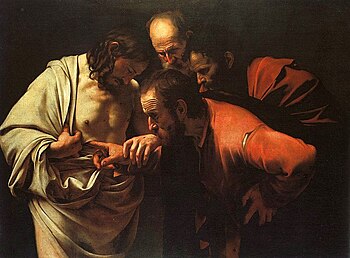
Are you a doubting Thomas?

Blessed are You have not Seen and yet STILL BELIEVE!

Saint Thomas, apostle - Feast                       Wednesday, 03 July 2013

Ephes. 2:19-22.
Brothers and sisters: You are no longer strangers and sojourners, but you are fellow citizens with the holy ones and members of the household of God,
built upon the foundation of the apostles and prophets, with Christ Jesus himself as the capstone.
Through him the whole structure is held together and grows into a temple sacred in the Lord;
in him you also are being built together into a dwelling place of God in the Spirit.

Ps 117(116):1.2.
Praise the LORD, all you nations;
glorify him, all you peoples!

For steadfast is his kindness for us,
and the fidelity of the LORD endures forever.
John 20:24-29.
Thomas, called Didymus, one of the Twelve, was not with them when Jesus came.
So the other disciples said to him, "We have seen the Lord." But he said to them, "Unless I see the mark of the nails in his hands and put my finger into the nailmarks and put my hand into his side, I will not believe."
Now a week later his disciples were again inside and Thomas was with them. Jesus came, although the doors were locked, and stood in their midst and said, "Peace be with you."
Then He said to Thomas, "Put your finger here and see my hands, and bring your hand and put it into my side, and do not be unbelieving, but believe."
Thomas answered and said to Jesus, "My Lord and my God!"
Jesus said to him, "Have you come to believe because you have seen me? Blessed are those who have not seen and have believed."

 Commentary of the day :
Have you ever been called a 'Doubting Thomas' and wondered what the origin of the expression was? Well, now you know. Thomas didn't see Jesus and refused to believe the testimony of his friends until Jesus Himself stood in front of him to show His wounds. So you are a Doubting Thomas if you refuse to believe someone who tells you something credible.
But the final words of Jesus are very encouraging today because they apply to all of you who are reading. "Blessed are you for believing" even though you have never met or seen Jesus.
You will be rewarded. Read what an early Church bishop had to say:

 Saint Peter Chrysologus (c.406-450), Bishop of Ravenna, Doctor of the Church
Sermon 84 ; PL 52, 438

The testimony of Thomas


Why did Thomas seek proof for his faith in this way?... Your love, my brethren, would have preferred it if lack of faith had left no one in doubt after the resurrection. But Thomas bore the uncertainty not only of his own heart but of all people. And since he was to preach the resurrection to the gentiles (now Jewish pagans) he sought out, like a good workman, what he would base a mystery on that demands so much faith. And the Lord showed all the apostles what Thomas had sought so late. “Jesus came... and showed them his hands and his side” (Jn 20,19-20). The person who entered, in fact, when the doors were shut, might have been taken for a spirit by the disciples if he had not been able to show them that it was none other than he, the wounds being the mark of his Passion.Then he came to Thomas and said to him:”Put your hand in my side and do not be unbelieving but believe. May the wounds you are opening once more make faith flow into the whole world, those wounds that have already poured out the water of baptism and the blood of redemption.” (Jn 19,34). Thomas replied: “My Lord and my God!” Let unbelievers come and hear and, as our Lord said, let them no longer be doubters but believers. Thomas makes known and declares that this is not just a human body but that, by the Passion of his body of flesh, Christ is God and Lord. He who comes out alive from death and who rises from his wounds is God indeed.


Monday, 1 July 2013

Two Minute Reflection on Mass Readings 2 July 2013

Where I attend Mass each day there are a variety of priests who celebrate the Mass and give the longest homilies. I am often falling asleep because they meander all over the place like a helicopter trying to find a place worth landing on.
This experience has given me the idea of providing a really brief daily reflection on the Mass readings. So as far as I am able I will attempt to do it from today on.
The readings are included and after you have read them and prayed to the Holy Spirit to give you some insights, it should only take you at most two minutes to read my thoughts (or more often the thoughts of someone far more holy than I).
Blessings to you for reading my blog.


Tuesday of the Thirteenth week in Ordinary Time     -     Tuesday, 02 July 2013

Genesis 19:15-29.

As dawn was breaking, the angels urged Lot on, saying, “On your way! Take with you your wife and your two daughters who are here, or you will be swept away in the punishment of the city."
When he hesitated, the men, by the LORD'S mercy, seized his hand and the hands of his wife and his two daughters and led them to safety outside the city.
As soon as they had been brought outside, he was told: "Flee for your life! Don't look back or stop anywhere on the Plain. Get off to the hills at once, or you will be swept away."
"Oh, no, my lord!" replied Lot.
"You have already thought enough of your servant to do me the great kindness of intervening to save my life. But I cannot flee to the hills to keep the disaster from overtaking me, and so I shall die.
Look, this town ahead is near enough to escape to. It's only a small place. Let me flee there--it's a small place, isn't it?--that my life may be saved."
"Well, then," he replied, "I will also grant you the favor you now ask. I will not overthrow the town you speak of.
Hurry, escape there! I cannot do anything until you arrive there." That is why the town is called Zoar.
The sun was just rising over the earth as Lot arrived in Zoar;
at the same time the LORD rained down sulphurous fire upon Sodom and Gomorrah (from the LORD out of heaven).
He overthrew those cities and the whole Plain, together with the inhabitants of the cities and the produce of the soil.
But Lot's wife looked back, and she was turned into a pillar of salt.
Early the next morning Abraham went to the place where he had stood in the LORD'S presence.
As he looked down toward Sodom and Gomorrah and the whole region of the Plain, he saw dense smoke over the land rising like fumes from a furnace.
Thus it came to pass: when God destroyed the Cities of the Plain, he was mindful of Abraham by sending Lot away from the upheaval by which God overthrew the cities where Lot had been living.

Ps 26(25):2-3.9-10.11-12.
Search me, O LORD, and try me;
test my soul and my heart.
For your mercy is before my eyes,
and I walk in your truth.

Gather not my soul with those of sinners,
nor with men of blood my life.
On their hands are crimes,
and their right hands are full of bribes.

But I walk in integrity;
redeem me, and have mercy on me.
My foot stands on level ground;
in the assemblies I will bless the LORD.

Matt 8:23-27.
As Jesus got into a boat, his disciples followed him.
Suddenly a violent storm came up on the sea, so that the boat was being swamped by waves; but he was asleep.
They came and woke him, saying, "Lord, save us! We are perishing!"
He said to them, "Why are you terrified, O you of little faith?" Then he got up, rebuked the winds and the sea, and there was great calm.
The men were amazed and said, "What sort of man is this, whom even the winds and the sea

Commentary of the day :

Blessed Charles de Foucauld (1858-1916), hermit and missionary in the Sahara
Meditation « Eight days at Ephraim », the calming of the tempest (trans. Charlotte Balfour, 1930)
"Why are you terrified?"


“My children, whatever happens to you, remember that I am always with you; remember whether you perceive me or not, whether I seem to be active or sleeping, forgetful of you, I am always watching and am always all-powerful. Never be afraid, never be anxious: I am there. I watch, I love... I am all-powerful. What more do you ask?.. Remember how many storms I have quieted by a word, making a great calm to follow. Remember how I held up Peter walking on the waters (Mt 14,28f). I am always as near to every person as I was then to him... Be confident, faithful, courageous; have no fear for your body and soul, for I am there, loving and all-powerful. But... do not let your confidence make you careless or neglectful of the dangers or confident in yourself or in others... You are in imminent danger. Evil spirits, those strong and crafty enemies, your own human nature, the world, make perpetual warfare upon you... In this life the tempest never ceases and your boat is ever ready to sink. But I am there, and with me it will never be wrecked. Trust nothing, yourself least of all; but in me have that perfect confidence that banishes fear.”

Two Minute Reflection on Mass Readings 2 July 2013

Where I attend Mass each day there are a variety of priests who celebrate the Mass and give the longest homilies. I am often falling asleep because they meander all over the place like a helicopter trying to find a place worth landing on.
This experience has given me the idea of providing a really brief daily reflection on the Mass readings. So as far as I am able I will attempt to do it from today on.
The readings are included and after you have read them and prayed to the Holy Spirit to give you some insights, it should only take you at most two minutes to read my thoughts (or more often the thoughts of someone far more holy than I).
Blessings to you for reading my blog.

Tuesday, 02 July 2013


Tuesday of the Thirteenth week in Ordinary Time

Genesis 19:15-29.
As dawn was breaking, the angels urged Lot on, saying, “On your way! Take with you your wife and your two daughters who are here, or you will be swept away in the punishment of the city."
When he hesitated, the men, by the LORD'S mercy, seized his hand and the hands of his wife and his two daughters and led them to safety outside the city.
As soon as they had been brought outside, he was told: "Flee for your life! Don't look back or stop anywhere on the Plain. Get off to the hills at once, or you will be swept away."
"Oh, no, my lord!" replied Lot.
"You have already thought enough of your servant to do me the great kindness of intervening to save my life. But I cannot flee to the hills to keep the disaster from overtaking me, and so I shall die.
Look, this town ahead is near enough to escape to. It's only a small place. Let me flee there--it's a small place, isn't it?--that my life may be saved."
"Well, then," he replied, "I will also grant you the favor you now ask. I will not overthrow the town you speak of.
Hurry, escape there! I cannot do anything until you arrive there." That is why the town is called Zoar.
The sun was just rising over the earth as Lot arrived in Zoar;
at the same time the LORD rained down sulphurous fire upon Sodom and Gomorrah (from the LORD out of heaven).
He overthrew those cities and the whole Plain, together with the inhabitants of the cities and the produce of the soil.
But Lot's wife looked back, and she was turned into a pillar of salt.
Early the next morning Abraham went to the place where he had stood in the LORD'S presence.
As he looked down toward Sodom and Gomorrah and the whole region of the Plain, he saw dense smoke over the land rising like fumes from a furnace.
Thus it came to pass: when God destroyed the Cities of the Plain, he was mindful of Abraham by sending Lot away from the upheaval by which God overthrew the cities where Lot had been living.

Ps 26(25):2-3.9-10.11-12.
Search me, O LORD, and try me;
test my soul and my heart.
For your mercy is before my eyes,
and I walk in your truth.

Gather not my soul with those of sinners,
nor with men of blood my life.
On their hands are crimes,
and their right hands are full of bribes.

But I walk in integrity;
redeem me, and have mercy on me.
My foot stands on level ground;
in the assemblies I will bless the LORD.
Matt 8:23-27.
As Jesus got into a boat, his disciples followed him.
Suddenly a violent storm came up on the sea, so that the boat was being swamped by waves; but he was asleep.
They came and woke him, saying, "Lord, save us! We are perishing!"
He said to them, "Why are you terrified, O you of little faith?" Then he got up, rebuked the winds and the sea, and there was great calm.
The men were amazed and said, "What sort of man is this, whom even the winds and the sea

Commentary of the day :

Blessed Charles de Foucauld (1858-1916), hermit and missionary in the Sahara
Meditation « Eight days at Ephraim », the calming of the tempest (trans. Charlotte Balfour, 1930)
"Why are you terrified?"


“My children, whatever happens to you, remember that I am always with you; remember whether you perceive me or not, whether I seem to be active or sleeping, forgetful of you, I am always watching and am always all-powerful. Never be afraid, never be anxious: I am there. I watch, I love... I am all-powerful. What more do you ask?.. Remember how many storms I have quieted by a word, making a great calm to follow. Remember how I held up Peter walking on the waters (Mt 14,28f). I am always as near to every person as I was then to him... Be confident, faithful, courageous; have no fear for your body and soul, for I am there, loving and all-powerful. But... do not let your confidence make you careless or neglectful of the dangers or confident in yourself or in others... You are in imminent danger. Evil spirits, those strong and crafty enemies, your own human nature, the world, make perpetual warfare upon you... In this life the tempest never ceases and your boat is ever ready to sink. But I am there, and with me it will never be wrecked. Trust nothing, yourself least of all; but in me have that perfect confidence that banishes fear.”


Sunday, 30 June 2013

If God came down to earth today would He find ten good men in Sydney?

Reflection on the readings of Mass for Monday, 01 July 2013

Monday of the Thirteenth week in Ordinary Time

Genesis 18:16-33.
Abraham and the men who had visited him by the Terebinth of Mamre set out from there and looked down toward Sodom; Abraham was walking with them, to see them on their way.
The LORD reflected: "Shall I hide from Abraham what I am about to do,
now that he is to become a great and populous nation, and all the nations of the earth are to find blessing in him?
Indeed, I have singled him out that he may direct his sons and his posterity to keep the way of the LORD by doing what is right and just, so that the LORD may carry into effect for Abraham the promises he made about him."
Then the LORD said: "The outcry against Sodom and Gomorrah is so great, and their sin so grave, that I must go down and see whether or not their actions fully correspond to the cry against them that comes to me. I mean to find out."
While the two men walked on farther toward Sodom, the LORD remained standing before Abraham.
Then Abraham drew nearer to him and said: "Will you sweep away the innocent with the guilty?
Suppose there were fifty innocent people in the city; would you wipe out the place, rather than spare it for the sake of the fifty innocent people within it?
Far be it from you to do such a thing, to make the innocent die with the guilty, so that the innocent and the guilty would be treated alike! Should not the judge of all the world act with justice?"
The LORD replied, "If I find fifty innocent people in the city of Sodom, I will spare the whole place for their sake."
Abraham spoke up again: "See how I am presuming to speak to my Lord, though I am but dust and ashes!
What if there are five less than fifty innocent people? Will you destroy the whole city because of those five?" "I will not destroy it," he answered, "if I find forty-five there."
But Abraham persisted, saying, "What if only forty are found there?" He replied, "I will forebear doing it for the sake of the forty."
Then he said, "Let not my Lord grow impatient if I go on. What if only thirty are found there?" He replied, "I will forebear doing it if I can find but thirty there."
Still he went on, "Since I have thus dared to speak to my Lord, what if there are no more than twenty?" "I will not destroy it," he answered, "for the sake of the twenty."
But he still persisted: "Please, let not my Lord grow angry if I speak up this last time. What if there are at least ten there?" "For the sake of those ten," he replied, "I will not destroy it."
The LORD departed as soon as he had finished speaking with Abraham, and Abraham returned home.

Ps 103(102):1-2.3-4.8-9.10-11.
Bless the LORD, O my soul;
and all my being, bless his holy name.
Bless the LORD, O my soul,
and forget not all his benefits.

He pardons all your iniquities,
he heals all your ills.
He redeems your life from destruction,
he crowns you with kindness and compassion.

Merciful and gracious is the LORD,
slow to anger and abounding in kindness.
He will not always chide,
nor does he keep his wrath forever.

Not according to our sins does he deal with us,
nor does he requite us according to our crimes.
For as the heavens are high above the earth,
so surpassing is his kindness toward those who fear him.


Mt 8:18-22.
When Jesus saw a crowd around him, he gave orders to cross to the other side.
A scribe approached and said to him, "Teacher, I will follow you wherever you go."
Jesus answered him, "Foxes have dens and birds of the sky have nests, but the Son of Man has nowhere to rest his head."
Another of (his) disciples said to him, "Lord, let me go first and bury my father."
But Jesus answered him, "Follow me, and let the dead bury their dead."

 Commentary of the day :

Saint Alphonsus Liguori (1696-1787), Bishop and Doctor of the Church
Address for the Octave of Christmas
"The Son of Man has nowhere to rest his head"


Address for the Octave of Christmas, no.8There are certainly some compassionate princes in the world who are glad to dedicate their wealth for the relief of the poor. But has anyone ever met a king who, to relieve the poor, has taken on their condition as Jesus Christ did? People tell, as though it were a phenomenon of charity, that the king, Saint Edward, meeting a lame and wholly destitute beggar on his path, took him lovingly onto his shoulders and carried him into the church. It's true that this was a great deed of charity that struck people with amazement, but following this deed Saint Edward did not renounce either his monarchy nor the wealth he possessed.Jesus, King of heaven and earth, to save mankind his lost sheep, was not satisfied, to the contrary, with coming down from heaven to look for it and set it on his shoulders (Lk 15,5): he did not hesitate to strip off his majesty, wealth and honors. He made himself poor..., the poorest of all. Saint Peter Damian says that he hid his purple, that is to say his divine majesty, under the appearance of a poor workman. Saint Gregory Nazianzen exclaims: “He who gives their wealth to the wealthy chooses poverty for himself so as to win us, by his merits, not the poor, passing possessions of this earth but heavenly possessions, vast and eternal.” His example invites us to detach ourselves from this world's wealth, which puts us at risk of being lost for ever (cf Mk 10,23).


Saturday, 29 June 2013

Pushing the Plough in a different direction

Commentary on today's readings at Mass
 
Sunday, 30 June 2013
 Thirteenth Sunday in Ordinary Time - Year C

 1 Kings 19:16-21. 

Then you shall anoint Jehu, son of Nimshi, as king of Israel, and Elisha, son of Shaphat of Abel-meholah, as prophet to succeed you.
If anyone escapes the sword of Hazael, Jehu will kill him. If he escapes the sword if Jehu, Elisha will kill him.
Yet I will leave seven thousand men in Israel--all those who have not knelt to Baal or kissed him."
Elijah set out, and came upon Elisha, son of Shaphat, as he was plowing with twelve yoke of oxen; he was following the twelfth. Elijah went over to him and threw his cloak over him.
Elisha left the oxen, ran after Elijah, and said, "Please, let me kiss my father and mother good-bye, and I will follow you." "Go back!" Elijah answered. "Have I done anything to you?"
Elisha left him and, taking the yoke of oxen, slaughtered them; he used the plowing equipment for fuel to boil their flesh, and gave it to his people to eat. Then he left and followed Elijah as his attendant.

Ps 16(15):1-2.5.7-8.9-10.11. 

Keep me, O God, for in you I take refuge;
I say to the LORD, “My Lord are you.
O LORD, my allotted portion and my cup,
you it is who hold fast my lot.”

I bless the LORD who counsels me;
even in the night my heart exhorts me.
I set the LORD ever before me;
With him at my right hand I shall not be disturbed.

Therefore my heart is glad and my soul rejoices,
my body, too, abides in confidence
because you will not abandon my soul to the netherworld,
nor will you suffer your faithful one to undergo corruption.

You will show me the path to life,
Fullness of joys in your presence,
The delights at your right hand forever.
 

Gal. 5:1.13-18. 
Brothers and sisters: For freedom Christ set us free; so stand firm and do not submit again to the yoke of slavery.
For you were called for freedom, brothers. But do not use this freedom as an opportunity for the flesh; rather, serve one another through love.
For the whole law is fulfilled in one statement, namely, "You shall love your neighbor as yourself."
But if you go on biting and devouring one another, beware that you are not consumed by one another.
I say, then: live by the Spirit and you will certainly not gratify the desire of the flesh.
For the flesh has desires against the Spirit, and the Spirit against the flesh; these are opposed to each other, so that you may not do what you want.

But if you are guided by the Spirit, you are not under the law.

Lk 9:51-62. 

When the days for Jesus to be taken up were fulfilled, he resolutely determined to journey to Jerusalem, and he sent messengers ahead of him. On the way they entered a Samaritan village to prepare for his reception there, but they would not welcome him because the destination of his journey was Jerusalem.

When the disciples James and John saw this they asked, "Lord, do you want us to call down fire from heaven to consume them?"

Jesus turned and rebuked them, and they journeyed to another village.

As they were proceeding on their journey someone said to him, "I will follow you wherever you go."

Jesus answered him, "Foxes have dens and birds of the sky have nests, but the Son of Man has nowhere to rest his head."

And to another he said, "Follow me." But he replied, "(Lord,) let me go first and bury my father."

But he answered him, "Let the dead bury their dead. But you, go and proclaim the kingdom of God."

And another said, "I will follow you, Lord, but first let me say farewell to my family at home." To him Jesus said, "No one who sets a hand to the plough and looks to what was left behind is fit for the kingdom of God."

Commentary of the day :
I used to use the last line of Jesus’s message today as the motivation for me to keep going with priesthood even though I was finding it exceedingly difficult and the tasks unrewarding. I also feared giving up the role knowing many people would use this text against me in condemnation - which some eventually did.

“You took your hand off the plough and looked back... you are not fit for the Kingdom!” was a typical criticism. I expected it and as the comment was made mostly by total strangers, it didn’t hurt as much as it would have if it was said by someone I cared about.

However I have tried to justify myself by claiming not to have given up my role. I have not stopped caring for the people entrusted to me by our Lord and I have continued to push the plough in a different direction.

Jesus made this statement I feel to encourage people to keep at the task of preaching the Gospel once they decided to follow Him and not look back at the lack of finances they suffer as a result of giving up their employment.
A Vietnamese friend, Frank Vuong Nguyen taught me how to drive a tractor on his farm in Riverstone and as I was doing the ploughing this day I kept looking behind me when I was driving to see if I was making straight furrows, but to my surprise they were really wavy lines. He said, "Didn't you hear Jesus words, 'Don't look behind you'? Just keep your eyes in the direction you want to go and the tractor (plough) will just make a straight course. He said, "You have got to keep your eyes on where you want to be". In a spiritual analogy, you have to keep your eyes on Jesus the Christ.
Just like Peter sank when he was walking on the water, because he looked at the waves and took his eyes off Jesus who had called him to come, we must keep our eyes on Jesus who calls us to follow Him and not take notice of the nay-sayers around us or the waves of difficulty and we will sail in a straight line to Jesus our destination.
St Paul writing to the Galatians reminds them that our spiritual nature and our physical nature are opposed to each other. This explains what I was saying to Val in an earlier post. The desire within us to make a difference in the world and leave some lasting proof of our connection to Jesus Christ is not as strong as our desire to have immediate personal fulfilment and happiness. Our humanity is stronger therefore than our spirituality. But ultimately it is our spirit that outlives our body so it makes sense to expend energy in assuring our eternal happiness with God by doing spiritually valuable things.
OK that’s me. What about you?

How do you read this passage? What does it have to say to you?
Have you made excuses for following Jesus? Do you have a valid reason for not doing the mission God made you for?

Comments from Pope John XXIII (1881-1963), pope

 Journal of a soul, June 1957 [before his election as Pope] (trans.©Geoffrey Chapman, 1965)

"I will follow you wherever you go"

“Give me more light as evening falls.” O Lord, we are now in the evening of our life. I am in my seventy-sixth year. Life is a great gift from our heavenly Father. Three-quarters of my contemporaries have passed over to the far shore. So I too must always be ready for the great moment. The thought of death does not alarm me... My health is excellent and still robust, but I cannot count on it. I want to hold myself ready to reply “adsum” at any, even the most unexpected moment. Old age, likewise a great gift of the Lord's, must be for me a source of tranquil inner joy, and a reason for trusting day by day in the Lord himself, to whom I am now turned as a child turns to his father's open arms. My poor life, now such a long one, has unwound itself as easily as a ball of string, under the sign of simplicity and purity. It costs me nothing to acknowledge and repeat that I am nothing and worth precisely nothing. The Lord caused me to be born of poor folk, and he has seen to all my needs. I have left it to him... Truly, “the will of God is my peace” (Dante Alighieri). And my hope is all in Jesus' mercy... I think the Lord Jesus has in store for me, before I die, for my complete mortification and purification and in order to admit me to his everlasting joy, some great suffering and affliction of body and spirit. Well, I accept everything and with all my heart, if it is for his glory and the good of my soul and for the souls of my dear spiritual children. I fear my weakness in bearing pain; I implore him to help me, for I have little faith in myself, but complete faith in the Lord Jesus. There are two gates to paradise: innocence and penance. Which of us, poor frail creatures, can expect to find the first of these wide open? But we may be sure of the other: Jesus passed through it, bearing his Cross in atonement for our sins, and he invites us to follow him.